
  Page 3.
|
 |
Philosophy of Chinese numerology. |
-
Except for concepts "san gan wu chan" (three foundations and five
constancies) in Confucian philosophy there is concept "zheng ming" (correction
or rectification of names) which consists that the man should correspond to the
social role and if essence of the man (individual qualities) do not coincide
with a post (name) then the name demands correction. This is basic understanding
of individuality in Confucian philosophy as Confucius believed that
observance of hierarchical norms of mutual relation and display of moral
qualities is a sufficient condition for achievement of world harmony, and
Confucius did not give value for individuality of the man as such.
In a context of Confucian philosophy the concept "ming" (names) means acceptable
social roles which correspond to essence of the man that corresponds with
physiognomic sphere of a nose which means individuality. That is
names are necessary for understanding as social roles which are peculiar to
people depending on the expressed and not expressed contours of a face in
profile, that is shown in the table:
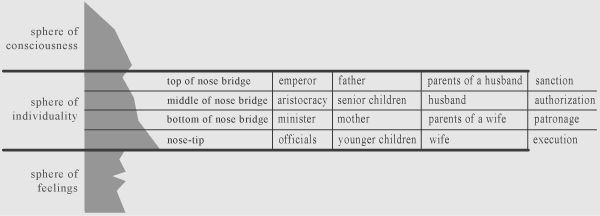
The physiognomic sphere of individuality is divided into four levels which
correspond with three orders of names (orders of social roles).
The first order of names: emperor - aristocracy - minister -
officials.
To top of nose bridge there corresponds the social role of emperor,
namely if the top of nose bridge is expressed then the person can name itself
emperor as environmental people perceive equivalence of personal essence with a post
of emperor, that is caused by conservative properties of individuality that are
connected to top of nose bridge.
To middle of nose bridge there corresponds the social role of aristocracy, namely
if the middle of nose bridge is expressed then the person seems aristocratically,
that is caused by a combination of conservative and arbitrary properties of
individuality that are connected to top and middle of nose bridge.
To bottom of nose bridge there corresponds the social role of minister,
namely if the bottom of nose bridge is expressed then behavior
of minister is adequate for the person, that is caused by a combination of arbitrary and radical properties
of individuality that are connected to the bottom of nose bridge and to the nose-tip.
To nose-tip there corresponds the social role of an official, namely if the
nose-tip is expressed then behavior of an official is adequate for the person,
that is caused by radical properties of individuality that are connected with
the
nose-tip.
Conservative, arbitrary and radical properties of individuality are necessary
for understanding in frameworks of the nine-level physiognomic system where the
nose is divided into three levels and corresponds with three kinds of
individuality about what it is told on this website in the previous section:
half faces (concepts 1). Differential
comparison of three and four physiognomic levels of a nose is in essence above
given, and ratio of four social roles and three kinds of human individuality is
proved.
The second order of names: father - senior children - mother
- younger children.
To top of nose bridge there corresponds the social role of a father, namely if
the top of nose bridge is expressed then the person seems conservative and
consequently can be higher in relations with children.
To middle of nose bridge there corresponds the social role of senior children,
namely if the middle of nose bridge is expressed then it seems that the person
has the superiority and consequently can dominate in system of family
interrelations.
To bottom of nose bridge there corresponds the social role of a mother, namely if
the bottom of nose bridge is expressed then the person has psychological
functions which in system of family interrelations can be carried out by mother.
To nose-tip there corresponds the social role of younger children, namely if the
nose-tip is expressed then the person seems radical and consequently corresponds
with a younger child from the point of view of other members in family.
It is necessary to mean that real features at members of this or that family
can not correspond to Confucian system, but it does not mean that social roles (family roles) do not correspond to
essences from the point of view of physiognomy. Actually father can play a role of mother or senior children, and
senior children can play a role of the father or mother, and also other members
of family can play different family roles depending on the expressed or not
expressed physiognomic features. It is the reason of different types of family
interrelations provided that there are no correct or wrong family
interrelations, but there are different individualities which form different
families.
The third order of names: parents of a husband - husband -
parents of a wife - wife.
To top of nose bridge there corresponds the social role of parents of a husband,
namely if the top of nose bridge is expressed then the person adheres to family
traditions, that is caused by the expressed conservative properties of
individuality. If the woman has the expressed top of nose bridge then the woman adheres
to traditions which are peculiar to parents of the husband.
To middle of nose bridge there corresponds the social role of a husband, namely if
the middle of nose bridge is expressed then it seems that the person plays
conducting (predominating) role that can be equally adequate for the man and for
the woman.
To bottom of nose bridge there corresponds a social role of parents of a wife,
namely if the bottom of nose bridge is expressed then female traditions prevail
in matrimonial interrelations, provided that female traditions are
economic (household), as against male traditions according to which the family
ideology is formed.
To nose-tip there corresponds the social role of a wife, namely if the nose-tip
is expressed then the person has a conducted role according to which one spouse
supposes advantage (crucial importance) of other spouse. If the man has the
expressed nose-tip then equality of the husband and the wife is probable in
matrimonial interrelations.
Thus three orders of names correspond with physiognomic levels of
individuality and determine various variants according to which public state and
private family interrelations of people are formed. More detailed information on
various variants of human interrelations in the state and in a society look in
Confucian books, and also in other sources of information.
It is necessary to tell that the first order of names is
authentically known in Confucian philosophy, and the second and third orders in detail are not described.
Namely Confucian philosophy speaks about interrelations of emperor, aristocracy,
minister, officials, and only mentions about relations of a father and a son,
a husband and a wife. Namely Confucian philosophy does not describe four levels
of interrelations in which children participate, and also parents of a husband
and a wife participate. Therefore social roles of senior and younger children,
and also social roles of parents are addition
for Confucian philosophy, that is necessary for understanding of four levels in
system of human interrelations in a context of physiognomy.
Three order of names in aggregate form philosophical and physiognomic system
which is valid not only in a context of Confucian philosophy but also is valid
in a context of any other philosophy. Namely to top of nose bridge there
corresponds "sanction" which is peculiar to emperor, to father, to parents
of a husband. To middle of nose bridge there corresponds "authorization" which
is peculiar to aristocracy, to senior children, to a husband. To bottom of nose
bridge there corresponds "patronage" which is peculiar to minister, to mother, to parents of a wife. To
nose-tip there corresponds "execution" which is peculiar to officials, to
younger children, to a wife.
According to the sanction - people issue or approve decrees, and according to
authorization - people confirm or initiate decrees. Namely emperor issues a
decree and aristocrats (boyars) confirm it, or aristocrats initiates a
decree and emperor approves it.
According to the patronage - people carry out supervision on execution of decrees,
and according to execution - people carry out decrees. Namely minister is the
supervisor and the representative of the Supreme authority, and officials are
direct executors and chiefs according to whom the decree can be carried out.
The sanction and authorization are legislature authority, and the patronage and execution
are executive authority.
Besides four levels of physiognomic sphere of individuality are comparable to
types of temperament about what look the information
at this website in the previous section: half faces (concepts 1).
It does not mean that social roles are peculiar to types of temperament, but
means that psychological parameters of activity and emotions, which are caused
by parameters of temperament, are acceptable to each social role. Otherwise it
is possible to tell that ratio of levels of a nose with types
of temperament specifies psychological features, and ratio with social roles specifies adequacy of the person for a
nominal post. Provided that the person can be adequate for a nominal post from the
point of view of people, as people estimate a social role
of the person, but psychological parameters of temperament (activity and
emotions) do not depend on opinion of people. But nevertheless social roles
associate with display of different temperaments, as each temperament and each social role correspond with one certain
physiognomic level of a nose from the point of view of physiognomy.
And also four levels of physiognomic sphere of a nose (sphere of individuality)
can be compared with digrams I Ching which are components of Chinese numerology:
top of nose bridge
 - number 8 and sad emotions;
middle of nose bridge
 - number 7 and joyful emotions;
bottom of nose bridge
 - number 9 and quiet emotions;
nose-tip
 - number 6 and open emotions.
Parities of physiognomic levels with digrams I Ching corresponds to ratios with emotions about what look the information
at this website in the other
section which has the name: concepts of
canon of changes.
-
Total in Chinese numerology there are three numerical sets which correspond
to a triangle, to a square, to a pentagon, or otherwise it is possible to tell
that the triangle, the square, the pentagon are basic figures of Chinese
numerology according to which the world is considered as probable combinations
and ratios of three and four and five numbers. Provided that numbers in Chinese
numerology differ from understanding of numbers in Pythagorean numerology as
mean other categories of the world.
The triangle, square (quadrangle), pentagon of Chinese numerology can be
presented as the chart:
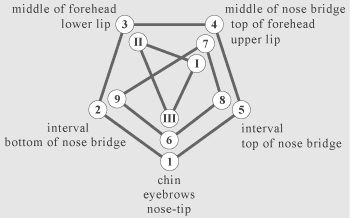 |
Roman figures I II III mean a triangle of physiognomic
sphere of consciousness and designate hierarchical norms of human
relations. Numbers 6978 mean a quadrangle of physiognomic sphere of individuality and designate four social roles. Numbers 12345 mean a pentagon of physiognomic sphere of feelings and designate five elements of the Chinese philosophy, and also moral qualities. Twelve white circles correspond to the twelve-level physiognomic system which is identical to the sacred Egyptian triangle with the attitude of sides 3:4:5, and also is analogue of geometrical figures and numerical sets of Chinese numerology. More detailed information about Chinese numerology and also the information on ratio of numerical sets and values of numbers in Chinese numerology I shall try to publish in the future. |
By means of the shown chart it is possible to carry out physiognomic
analyses and to describe structure of a human personality. Namely it is possible to
note white circles which correspond to the expressed features of the human face.
And after that it is possible to analyze ratio of physiognomic levels in spheres of
consciousness and individuality and feelings according to ratios which form a
triangle, a quadrangle, a pentagon.
During physiognomic analyses it is necessary to distinguish social roles
which correspond with physiognomic sphere of individuality, and hierarchical
norms of mutual relations which correspond with physiognomic sphere of
consciousness. Namely hierarchical norms of relations are derivatives of
consciousness and mean allowable rules which the person resolves to
environmental people, and social roles are derivatives of
individuality and mean possible position of the person in a society according to the point of view of environmental people.
And also it is necessary to distinguish moral qualities which correspond with
physiognomic sphere of feelings, that in a result allows to compare and analyze
moral qualities, hierarchical norms of mutual relations, social roles in a
context of Confucian philosophy, and also in a context of Chinese numerology and philosophy as a whole.
The following page results concepts of ancient Greek philosophy which can be considered from the point of view of physiognomy of a human face.
-


