
   Page 4.
|
 |
Elements of ancient Greek philosophy. |
-
The ancient Greek philosophy is a conglomerate of opinions of many
philosophers who had different sights at world around and at the man in the
world, but who in aggregate have made universal representation about essence of
human life. Namely the understanding of life had different sense in a context of
different philosophical systems, but in aggregate opinions of Greek philosophers
form universal representation about the human world.
General in philosophical systems of ancient Greece is a division of human
essence into two parts which correspond with physiognomic spheres of
consciousness and feelings.
Plato considered that the consciousness is essential, and feelings are
insignificant. Aristotle considered that essential is not only consciousness,
but also feelings. Epicurus considered that feelings are essential only.
Actually disagreements of the Greek philosophers consist in different concepts
of human life which is essential according to consciousness and-or feelings that
is connected with the expressed and not expressed physiognomic spheres of
consciousness and feelings. As consciousness is significant for the person with
the expressed forehead and eyebrows, and feelings are significant for the person
with the expressed lips and chin.
According to Plato's philosophy the person denies sensual perception and then
overcomes errors and realizes original images of things, but according to
philosophy of Epicurus the errors result from mistakes of consciousness, and
feelings are criterion of authenticity in opinions about the world, that
characterizes two people whose spheres of consciousness and feelings are
expressed differently. According to philosophy of Aristotle the person by means
of feelings perceives qualities of things and by means of consciousness defines
an essence of things, that characterizes the person with equally expressed
spheres of consciousness and feelings.
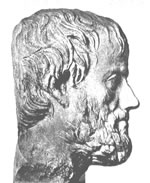 Aristotle. |
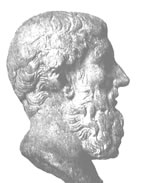 Epicurus. |
As it is possible to see in sculptural images the
facial profile or half-face of Aristotle has equally expressed physiognomic
spheres of consciousness and feelings that specifies the identical
importance of consciousness and feelings in philosophy of Aristotle. The facial profile or half-face of Epicurus has more expressed physiognomic sphere of feelings in comparison with sphere of consciousness that specifies prevalence of feelings in philosophy of Epicurus. |
Sphere of consciousness.
The physiognomic sphere of consciousness can be described by means of
philosophical concepts of Socrates who distinguished three types of
consciousness according to which the man comprehends world around, that is
comparable to three physiognomic levels of consciousness. The highest level (top of forehead) gives general objective knowledge which is
formed of subjective knowledge of separate people by means of comparison of
different opinions. Namely subjective knowledge arise at the bottom level
(eyebrows), and comparison of subjective knowledge occurs on the average level
(middle of forehead) and as a result there is the objective knowledge.
Philosophical method of Socrates assumed joint search of true when interlocutors
compare subjective opinions and as a result reach objective knowledge. The
purpose of knowledge was objective comprehension according to which positive
existence is possible. Namely according to philosophy of Socrates objective
knowledge determine positive displays of feelings, and if knowledge are not
objective then feelings are not shown positively and are caused by errors of
consciousness.
From the point of view of physiognomy it means that the man is capable to show
feelings positively if the man has expressed physiognomic sphere of consciousness
(forehead and eyebrows) which dominates over physiognomic sphere of feelings
(lips and chin). Provided that the sphere of consciousness
consists of three levels according to which the man is declined or is not
declined to compare subjective opinions of people and to find objective
knowledge.
Understanding of positive existence was other in a context of Epicurus'
philosophy, namely positive there were displays of feelings which are not caused
by influence of consciousness, and in essence not caused by comparison of human
opinions and searching of objective knowledge. The purpose of Epicurus'
philosophy was the serene existence discharged of public consciousness of
people, that from the point of view of physiognomy is possible if the sphere of
feelings (lip and chin) is expressed. Namely if the consciousness of the man is
not caused by public alarms and ideas on processes occurring in the world then
satisfaction own feelings is possible.
The philosophy of Epicurus was not predominating as in the Greek culture there
was characteristic of consciousness superior over feelings, and consequently
the human image was ideal if the man was the interested member of a society
and if the man realizes a civic duty according to which feelings are caused by objective
understanding of public necessity, that is possible to see in the shown
classical Greek profile of half-face:
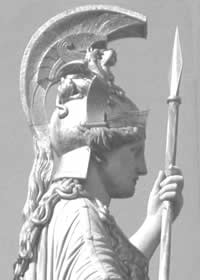 |
The classical or antique Greek profile of half-face is ideal image
of the man from the point of view of the Greek culture, and in
particular in the view of Plato's philosophy. Considerably expressed forehead in comparison with the not expressed lips and chin specifies prevailing sphere of consciousness according to which feelings are subordinated to the realized necessity. The expressed top of nose bridge and not expressed nose-tip specify prevalence of conservative features over radical features of individuality, that is a parameter of super individuality by which the man is self-identified. The expressed upper lip specifies regulated display of feelings according to public norms of behavior. The expressed interval between chin and lower lip specifies character traits according to which the opinion of environmental people is important for the man, namely it is necessary for the man that displays of own feelings were acceptable to associates. |
-
Sphere of individuality.
The physiognomic sphere of individuality is possible for describing by means of
philosophical concepts of Democritus, as authentic understanding of human individuality is achievable
only according to philosophical concepts of Democritus. From the point of view
of Socrates' or Plato's or
Aristotle's philosophies the human essence consists of two parts, but according
to philosophy of Democritus except for consciousness and feelings there is a connection of atoms
which form individuality.
Philosophy of Democritus is a doctrine about atoms which form a nature of
things, but the understanding of atoms differed from modern understanding, namely
initially Democritus spoke about atoms as the least particles of life, but later philosophers
began to understand atoms as the least particles of a
matter that differs from primary sense.
There are uncountable sets of atoms
which differ with the sizes and forms, and atoms have movement that in result
conducts to connection of atoms and formation of various objects of the world
(phenomena of life), and including results in formation of various human
individualities. Atoms can be perceived by consciousness but can not be
perceived by feelings, namely atoms cannot be felt but it is possible to think of them.
Namely atoms are not material and do not form material substance, but form
essence of the world phenomena, and including form non-material human essence which is individuality.
Among a huge variety of atoms there are four types which correspond with
four elements: fire, water, earth, air. Namely atoms have various forms and the sizes
but in aggregate have four qualities that is shown on the scheme:
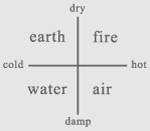 |
Cold and dry atoms have qualities of earth. Dry and hot atoms have qualities of fire. Hot and damp atoms have qualities of air. Damp and cold atoms have qualities of water. Qualities of fire or air or water or earth can prevail in world phenomena according to combinations of atoms. Namely if any phenomenon of the world is formed by a combination of atoms among which atoms of any one type prevail then the prevailing quality of this phenomenon corresponds with quality of prevailing atoms. |
Thus according to philosophy of Democritus it is possible to speak that human
individualities consist of combinations of atoms which are not a matter but form
non-material essence. Or otherwise it is possible to speak that atoms do not
form a firm matter but form a thin material skeleton on which the firm matter
is strung, though in philosophy of Democritus there was no concept "thin matter"
but it is possible to apply this term to understanding of atoms.
Types of alive essences differ by combinations of
atoms and by qualities of prevailing atoms. The man differs from animals by a
special arrangement of atoms. If the material body collapses then atoms of
individuality dissipate in space, and consequently human individuality is mortal.
More detailed information on atoms of individuality and also the information
on ratio of atoms with human feelings and consciousness look on the
following page.
From the point of view of physiognomy the individuality of the man corresponds
with a nose, and consequently depending on the expressed and not expressed
physiognomic levels of a nose it is possible to speak about qualities of
prevailing atoms of which individuality is formed, that is shown in the table
(look on the following page).
The top of nose bridge specifies atoms with quality of water. If the top of nose
bridge is expressed then individuality of the man is damp and cold.
The middle of nose bridge specifies atoms with quality of fire. If the middle of
nose bridge is expressed then individuality of the man is dry and hot.
The bottom of nose bridge specifies atoms with quality of earth. If the bottom
of nose bridge is expressed then individuality of the man is cold and dry.
The nose-tip specifies atoms with quality of air. If the nose-tip is expressed
then individuality of the man is hot and damp.
It is necessary to take into account that human individuality is a
combination of atoms of all types and consequently at structure of individuality
there are all qualities, but if any levels of a nose are more expressed then qualities of
prevailing atoms are most appreciable.
The listed elementary qualities of atoms are comparable to types of
temperament, namely the temperament of melancholic man corresponds with
prevalence of water. The temperament of choleric man corresponds with prevalence
of fire. The temperament of phlegmatic man corresponds with prevalence of earth.
The temperament of sanguine man corresponds with prevalence of air.
Sphere of feelings.
The physiognomic sphere of feelings corresponds with five initial potentialities
according to which the material world is formed.
In philosophical systems of Socrates, Plato, Aristotle, Democritus, Epicurus or
in other philosophical systems of ancient Greek there is no sufficient systematized
comparison of human feelings with initial potentialities of the world, though
there is the understanding according to which feelings are derivatives of a
matter and are caused by perception of the material world. But in myths of ancient Greece and in particular in the
mythological Theogony of Hesiod it is possible to see that structures of a material world
are
systematized enough for comparison with physiognomy of a human face. Namely in
Greek myths the matter is a conglomerate of Chaos, Eros, Gaia, Tartarus, Uranus
who are comparable to five physiognomic levels in sphere
of feelings that is shown on the scheme:
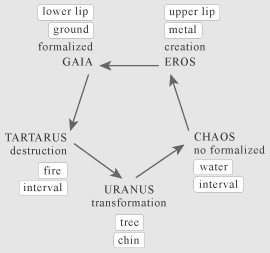 |
Chaos corresponds with the interval between nose and
upper lip, and means a no formalized condition of a matter. Eros corresponds with the upper lip and means creation according to which the matter passes from a no formalized in a formalized condition. Gaia corresponds with the lower lip and means the formalized condition of a matter. Tartarus corresponds with the interval between lower lip and chin, and means destruction of a formalized matter. Uranus corresponds with the chin and means transformation of a matter, agrees to what there can be occurrence of new kinds of a matter, namely if transformation does not occur then destruction results in a no formalized chaotic condition of a matter, but if there is a transformation then the matter finds new properties. |
The initial potentialities are personal names in Greek myths, but in philosophy the initial potentialities are terms which mean various
conditions of a matter, and in physiognomy or psychology
the initial potentialities mean processes according to which the man carries out
sensual perception of the material world.
Five initial potentialities of the Greek mythology correspond
with five initial elements of the Chinese philosophy. Namely Chaos corresponds
with water. Eros corresponds with metal. Gaia corresponds with ground. Tartarus
corresponds with fire. Uranus corresponds with tree.
Pay attention that five initial potentialities or five initial elements are
not identical to four elements. Namely four elements: fire, earth, water, air
are not identical to five initial potentialities of the Greek mythology: Chaos,
Eros, Gaia, Tartarus, Uranus, also are not identical to five initial elements of
the Chinese philosophy: tree, fire, ground, metal, water, as mean the different
world phenomena and correspond with different spheres of human essence.
Chaos (water) is a no formalized matter or not actual
existence of bodies. It is shapeless and all-consuming "awful chasm" from which
there were initial sources of the material world.
If from the point of view of physiognomy the interval between nose and upper
lip is expressed then the man perceives the world vaguely as chaotic space in
which feelings are no objective.
Some Greek philosophers assumed that the beginning of the material world is water,
and consequently the parity of Chaos with water is proved.
Eros (metal) is a principle of creation or process as a
result of which the no formalized matter gets a shape.
In mythology Eros is comparable to the god of love Eros or it is possible to
tell that the god Eros is personification of cosmic Eros.
If from the point of view of physiognomy the upper lip is expressed then
characteristics of the man can be compared to characteristics of the god Eros
who is the smart ruthless kid who personifies thirst of love possession, but who
also has courage and resistance. Namely Eros uses force of the goddess of love
Aphrodite who is mother of Eros. In some myths of ancient Greece the god Eros
associated with a stone that is comparable to metal.
In essence if the upper lip is expressed then the man aspires to connection of
isolated feelings of people for the sake of structuring of sensations according to which
people perceive the world.
Gaia (ground) is the formalized matter which is formed
during creation.
In myths of ancient Greece the Gaia is mother of gods and personification of the
material world. Comparison of Gaia with ground is proved as Gaia is the
ground-mother.
According to concepts of modern materialistic philosophy (physical
philosophy) the matter consists of atoms, but the modern understanding of atoms
differs from understanding of atoms in a context of philosophy of Democritus,
that was told above. Namely the Gaia is personification of an
appreciable matter but atoms of Democritus are particles which form
individuality of the man.
Gaia is not involved in activity of gods but gives force for Demeter who is the
goddess of earthly blessings, and also gives force for Cybele who is the goddess
of sensual orgies and excitation of a nature. Therefore if from the point of
view of physiognomy the lower lip is expressed then character of the man can be
compared to characters of Demeter or Cybele.
The information on characters of gods look in myths of ancient Greece.
And also the information on characters of the
Greek gods look on pages of this website in section with the name:
half faces (concepts 5).
In essence if the lower lip is expressed then the man has direct and stressed
sensual perception of the world.
Tartarus (fire) is a "monstrous chasm which even gods are
afraid". Tartarus means a principle of destruction of the matter that differs from
Chaos who is a condition of the matter, but Tartarus is process as a
result of which the formalized matter passes in a no formalized condition.
Therefore Tartarus is monstrous if process of destruction has no end and becomes
a constant, that is a synonym of the fiery Gehenna and is comparable to fire.
If from the point of view of physiognomy the interval between lower lip and
chin is expressed then the man limits direct perception of the world and
hinders from spontaneous display of feelings, and in essence the man breaks an
organic nature of the material world.
Uranus (tree) is a transformation of the matter.
From the point of view of modern physical philosophy it is possible to tell that
Uranus symbolizes transformation of a lifeless matter into alive matter, and
consequently in a context of ancient Chinese philosophy Uranus can be compared with
the element of
tree which is the unique "alive" symbol among five initial elements of
the material
world.
In ancient Greek philosophy Uranus personifies the sky and symbolizes
unrestrained forces according to which he gives rise to gods, namely Uranus is the
spouse of Gaia, and he in the union with Gaia transforms the matter which without
transformation is exposed to destruction and comes back in Chaos.
If from the point of view of physiognomy the chin is expressed then the man is
capable to embody own sensations, that similarly to creation of new kinds of a
matter. Namely the man perceives the world as space in which desires can be
realized.
It is necessary to distinguish mythological Uranus and the planet Uranus
which was named by this name. Namely it is necessary to distinguish
characteristics of the planet Uranus in astrology and a principle of
transformation of the matter. As characteristics of the Uranium in modern
astrology correspond with characteristics of Chaos in ancient Greek myths.
And also it is necessary to consider other inconsistencies of mythological and
astrological names. These inconsistencies are very interesting as allow to
understand an essence of world phenomena irrespective of names, and also allow
to understand the reasons as a result of which there was a confusion.
Thus five physiognomic levels in sphere of human feelings correspond with five
initial world potentialities according to which the man perceives the
material world. The first level (chaos) allows to perceive no concrete
sensations which proceed from material substance. The second level (eros) allows
to unite sensations. The third central level (gaia) allows to perceive
complete sensation of substance. The fourth level (tartarus) allows to filter
and eliminate unnecessary sensations. The fifth level (uranus) allows to
transform the matter and to create desirable sensations.
Five material initial potentialities of ancient Greek mythology mean stages of
existence (expansion) of the matter and have complex interrelations, that is
similar to interactions of five initial elements in ancient Chinese philosophy
about which it is told on the previous pages of this site section. At physiognomic
analyses of human faces it is necessary to take into account these
interactions, and also it is necessary to consider physiognomic parameters in
spheres of consciousness and individuality, that as a result allows to see the
general physiognomic and philosophical portrait of the man.
The following page gives the further comparisons of physiognomy of a human face with various concepts of ancient Greek philosophy.
-


