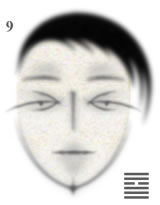
Human emotions and physiognomy.
Physiognomic image and hexagram Yih-King 9.
-
Lineaments of a face and perception of a time.
Eyebrows: ideas are outside of time / irrelative chronology of
subjective human comprehensions.
Eyes: aspirations are in the past / inevitably final chronology of
subjective human achievements.
Mouth: events are outside of time / irrelative chronology of subjective
human actions.
Person looks in the past but the past time as if was not.
Analytical formulas of the canon of changes.
1 (eyebrows) indefinite thinking is (mouth) vague
evidence of (eyes) unconvinced existence.
2 (eyebrows) forgotten reminiscences are (eyes)
disappearing displays of (mouth) doubtful past.
3 (mouth) non objective assumptions are (eyebrows)
uncertain projections of (eyes) irrelevant future.
Global space and time correspond with movement which is the third world category
according to which the world is organized, and consequently physical parameters
and psychological aspects of mental perception of movement are comparable with
hexagrams of the canon of changes and physiognomic symbols of facial emotions.
Namely quiet emotions of a human face can be compared with absence of movement
or a steady state of quiescence which keeps constant position in space. Joyful
emotions can be compared with acceleration of movement. Sad emotions with delay
of movement. Open emotional displays of a human face can be compared with
absolute movement which is equivalent to a maximal size or infinity of space.
-
Following 10 facial image in gallery.
About gallery of facial changes and psychological aspects of physiognomy, and also
emotional displays or mimic expressions.